Part Two — The Cracks
The Loneliness Inside
Loneliness

Statistics describe populations. They cannot describe the sound of two people eating dinner in silence. They cannot measure the weight of a hand not reached for, the sentence not finished because no one is listening. They cannot capture the particular loneliness of lying next to someone you no longer know how to talk to.
This chapter is about that loneliness. It is the emotional core of these pages — the place where the numbers become human.
The Performance of Togetherness
Walk into any restaurant on a Friday night and you will see them. Couples who look, from a distance, like the picture of contentment. They are dressed well. They split an appetizer. They talk about the logistics of the coming week — who's picking up the kids, whether the car needs servicing, what time the in-laws arrive on Sunday.
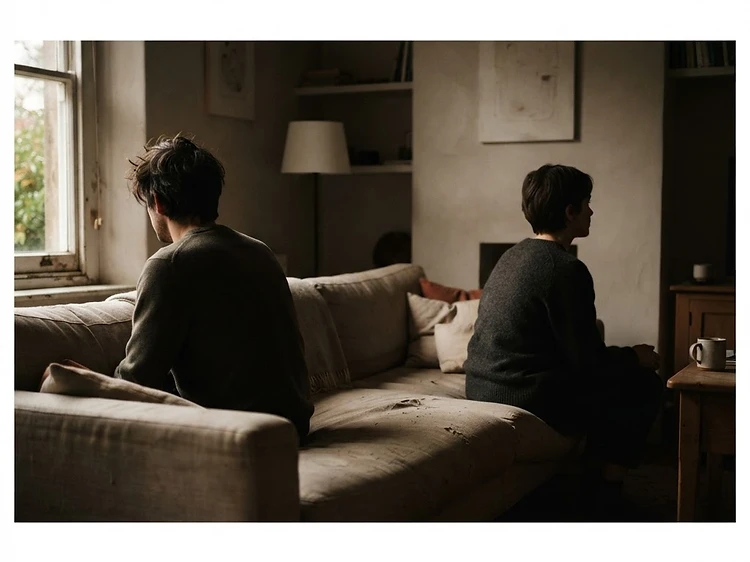
Now watch more closely. Notice how often one of them looks at their phone. Notice the pauses that stretch a beat too long. Notice how the conversation never touches anything that matters — not fear, not longing, not the slow accumulation of disappointments neither has named.
This is an illustration, not a study. But most readers will recognize it. It is the performance of togetherness — not a lie exactly, because both parties know the script, but a performance nonetheless, maintained for the benefit of an audience that includes everyone except themselves.
The sociologist Erving Goffman described social life as a series of performances, with a "front stage" where we manage impressions and a "back stage" where we relax. Applying that distinction to intimate partnership — an extension Goffman himself did not make — many couples find that the marriage itself has become the front stage, a presentation of unity, stability, and satisfaction, while the back stage is a place of silence, distance, and quiet despair.
The Data on Loneliness Within Marriage
You might assume loneliness is a problem of the unmarried. The data complicates the assumption.
Surveys, including work by the American Enterprise Institute, find that married adults are less likely to report feeling lonely often — but a meaningful share report the chronic, low-grade loneliness of feeling lonely sometimes, a category that accumulates over years without announcing itself.
The University of Michigan's National Poll on Healthy Aging found that among adults aged 50 to 80, a substantial minority of married respondents reported feeling lonely — lower than among unmarried respondents, but far from negligible. Marriage, the researchers observed, is no guarantee against loneliness.
Studies of marital loneliness — the feeling of being emotionally disconnected from one's spouse — have linked it to increased depressive symptoms and reduced life satisfaction, sometimes independent of overall marital satisfaction. In other words, you can be "happy" in your marriage by external measures and still feel profoundly alone within it.
The Silence That Accumulates
How does loneliness develop inside a relationship that began with connection?
It rarely happens suddenly. It is a slow process, a gradual closing of doors that neither partner notices until the house is fully sealed. Therapists who work with distant couples describe a pattern that often looks something like this:
Stage 1: Small disappointments unshared. A partner says something careless. You feel hurt but decide not to bring it up. It's not worth the conflict. You swallow it. The next time, it's slightly easier to swallow.
Stage 2: Vulnerability becomes risky. You share something tender — a fear, a fantasy, a dream — and your partner responds with distraction or dismissal. The message is received: this is not safe territory. You don't go there again.
Stage 3: The emotional accounting begins. You start keeping score. "I initiated last time. I asked about his day. I planned the weekend. Why is it always me?" Resentment builds. You stop initiating. Your partner doesn't notice — or notices and doesn't respond.
Stage 4: Parallel lives. You develop separate routines, separate friends, separate sources of meaning. You are functionally roommates who share a bed and a mortgage. The relationship is not hostile. It is empty.
Stage 5: Acceptance or exit. Some couples settle into this state permanently, calling it "companionship" or "mature love." Others reach a breaking point — an affair, a crisis, a quiet decision to leave.
This is one common pattern, not a universal sequence. But it captures how loneliness hardens from something that could have been named into something that no longer can.
The psychoanalytic tradition has a formulation: a common therapeutic formulation holds that the opposite of love is not hate but indifference. The couples who fight are still engaged. The couples who have stopped fighting are the ones who have given up.
The Gender Asymmetry of Marital Loneliness
The experience of loneliness within marriage is not evenly distributed.
Research, mostly focused on heterosexual couples, suggests that on average men rely more heavily on their spouses for emotional connection than women do. Women are more likely to maintain friendships, confide in family members, and seek emotional support outside the marriage. Men often have fewer alternative sources of support to turn to.
This creates a paradox. Women are more likely to feel lonely in marriage because their expectations for emotional connection are higher and their experience of disconnection is more acute. But men are more likely to become lonely if the marriage ends, because they have built fewer outside sources of support.
Studies in this area — including work published in Psychology of Men & Masculinities — find that men who report high loneliness within marriage are also more likely to experience depression and problematic drinking, but less likely to seek help. The cultural script that says men should be self-sufficient makes it difficult for them to admit loneliness, even to themselves.
The result is a kind of double silence: men who don't feel entitled to ask for connection, and women who are exhausted from having been the emotional connective tissue for years. This asymmetry is not just a personal failing. It is, in part, an artifact of how the institution loads a single relationship with the entire burden of emotional life — a load it was never designed to carry alone.
The Digital Distraction
The loneliness within modern marriage is amplified, not caused, by a novel factor: the smartphone.
According to industry reports such as DataReportal's annual Digital Global Overview, the average American adult spends several hours a day on their phone — often more waking time than they spend in sustained attention on their partner. Even when couples are physically together, they are frequently attentionally apart, each absorbed in their own algorithmic stream.
This is not a trivial matter. Research on "phubbing" — partner phone snubbing — published in journals including the Journal of Social and Personal Relationships has linked it to lower relationship satisfaction and higher loneliness. The message, received repeatedly, is: whatever is on this screen is more interesting than you are.


The cruel irony is that the same technology also feeds us a constant stream of images of other people's curated relationships. Social media is a machine for comparison, and the comparison is always against highlight reels. Your partner, with their flaws and their silence, cannot compete with the fantasy the feed provides.
The Affairs of the Unloved
Some people eventually break. Not in dramatic, movie-style explosions, but in small, quiet decisions that look, from the outside, like nothing at all.
An affair begins. Not necessarily a sexual one — though that happens too. Often it starts with conversation. Someone who listens. Someone who asks questions. Someone who makes you feel interesting, desirable, seen in a way you haven't felt in years.
The affair is not really about the other person. It is about the self that has been neglected. The affair is a way of proving that you still exist, that you are still capable of desire, that you are not just a function — a parent, a provider, a roommate.
The data on infidelity is notoriously unreliable, since it relies on self-report and definitions vary. Long-standing estimates from the General Social Survey and similar surveys put lifetime extramarital sex at roughly 20% of married men and 13% of married women, with women's figures having risen over recent decades. When emotional affairs are included, the numbers rise substantially.
These are not outliers, exactly. They are one of the predictable outcomes of a system that promises lifelong exclusive passion and then asks people to pretend the passion hasn't faded.
What Marriage Has Become
Here is the uncomfortable synthesis.
Marriage, as we have inherited it, is a legal and social container built for a world that has changed. As the historian Stephanie Coontz has documented, it was designed to manage property, secure bloodlines, and enforce religious norms, and was repurposed across the 18th and 19th centuries as a vehicle for romantic love and personal fulfillment.
That repurposing worked — for a while. It worked when women had few economic options, when divorce carried enormous social stigma, when life expectancy was short enough that "til death do us part" meant decades rather than the half-century many couples now face.
It works less well now. Women are economically independent. Divorce is normalized. Life expectancy has stretched the commitment longer than the institution was built for. And the biological realities described in Chapter 2 — the fade of passion, the tension between attachment and desire — play out over a much longer timeline than ever before.
The result is a growing mismatch between what marriage promises and what it can deliver. Many people are living inside that mismatch, keeping up appearances, feeling lonely, telling themselves this is just what marriage becomes.
But that is not the whole story. Some couples adapt. Some find ways to renegotiate, to build intimacy that doesn't depend on passion, to create structure that allows for both connection and autonomy. Some discover that the problem was never the person — it was the model.
The next chapters explore what those adaptations look like. Not a call to abolish marriage, but a call to expand our imagination about what committed partnership can be.
Further Reading
- American Enterprise Institute and the University of Michigan National Poll on Healthy Aging — on loneliness and marriage surveys.
- Journal of Marriage and Family; Psychology of Men & Masculinities; Journal of Social and Personal Relationships — on marital and gendered loneliness research.
- General Social Survey — on social attitudes and wellbeing.
- Stephanie Coontz — on the historical work on marriage.
- Broader literature on marital loneliness, phubbing, and infidelity.
As members add their voices, a live bar will appear here showing where this community sits in relation to the chapter — not agreeing or disagreeing with a verdict, but locating their own experience.
No voices here yet. Be the first to add yours.
Be kind. Be honest. Be on topic.
Sign in to add your voice to this chapter.