Part One — The Inheritance We Didn’t Choose
The Biology We Ignore
Biology

If marriage is a historical invention, what is it inventing against? What does the human animal actually come equipped with when it comes to bonding, desire, and long-term attachment?
The answer is uncomfortable for anyone invested in the romantic ideal: we are a species wired for intense early bonding, predictable passion decay, and a tension between attachment and novelty that no cultural script has fully resolved. Marriage — particularly lifelong, sexually exclusive marriage — asks us to override some of our most reliable biological patterns. Sometimes we succeed. Often we don't. And the cost of pretending otherwise is measured in quiet misery.
Sternberg's Triangle: A Map, Not a Destination
Robert Sternberg's triangular theory of love, first published in 1986, remains one of the most useful frameworks for understanding why relationships evolve the way they do. Sternberg proposed that love has three components:
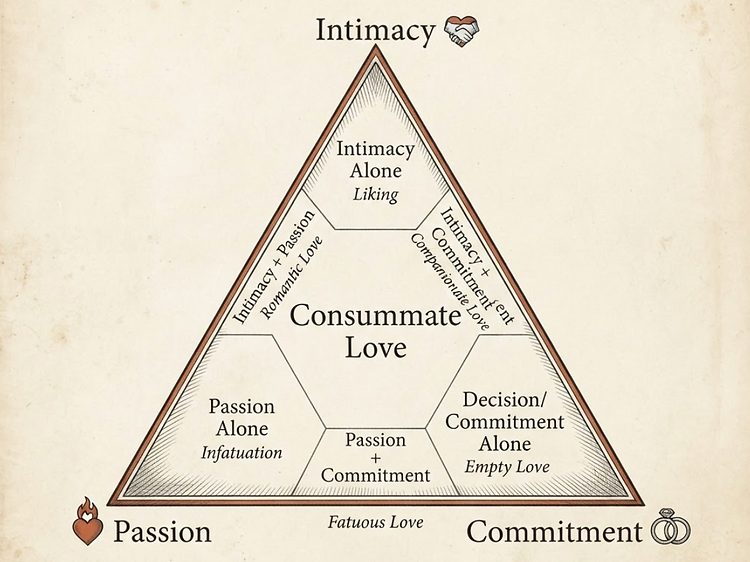
Intimacy — the feeling of closeness, connectedness, and bondedness. It's the warmth, the trust, the "we can talk about anything" dimension.
Passion — the drives that lead to romance, physical attraction, sexual consummation. It's the heat, the craving, the obsessive early phase that neuroscience tells us is closer to addiction than to affection.
Commitment — the decision to love someone and the decision to maintain that love over time. It's the cold, deliberate, "I choose this even when I don't feel like it" dimension.
Different combinations produce different kinds of love. Intimacy alone is liking. Passion alone is infatuation. Commitment alone is empty love. Intimacy plus passion is romantic love. Intimacy plus commitment is companionate love. All three together is consummate love — the complete form, the one we're all supposedly chasing.
Here's the problem: Sternberg himself noted that passion is the least stable component. It rises quickly, peaks early, and declines. Intimacy can grow slowly and sustain. Commitment is volitional — it can persist regardless of feeling. But passion follows a biological curve that no amount of communication, date nights, or couples therapy can permanently flatten.
This is not a failure of effort. It is a feature of the machinery.
The Neuroscience of Falling (and Staying)
Helen Fisher's work at Rutgers University, using fMRI scans of people in different stages of love, has mapped three distinct but overlapping systems:
Lust — driven primarily by testosterone and estrogen, the raw sexual drive that seeks gratification.
Attraction — driven by dopamine, norepinephrine, and serotonin. This is the obsessive phase: racing thoughts, loss of appetite, sleeplessness, euphoria. Fisher describes it as "a goal-directed state" that focuses all attention on a single partner.
Attachment — driven by oxytocin and vasopressin. This is the calm, secure, long-term bond that sustains partnerships and enables cooperative child-rearing.
The crucial insight: these systems do not operate on the same timeline. Lust is episodic. Attraction burns hot and fades — Fisher's work and related research place this phase at roughly twelve to thirty-six months, with estimates varying by study. Attachment can last for decades, but it produces a different feeling: safety, comfort, predictability. Not fireworks.
This mismatch is the source of a great deal of human suffering. People interpret the fade of attraction as the end of love. They conclude something is wrong — with their partner, with themselves, with the relationship. Often, nothing is wrong. The biology is simply doing what it evolved to do.
The Intimacy–Desire Paradox
Here is the counterintuitive finding that undermines nearly every piece of conventional relationship advice: emotional closeness can extinguish sexual desire.
Esther Perel, the Belgian-American psychotherapist whose work has brought this paradox to mainstream attention, puts it bluntly: love and desire are not the same thing. They don't always coexist, and they often pull in opposite directions.
The logic is almost perverse. Intimacy requires predictability, safety, and knowing. Desire requires mystery, novelty, and distance. Intimacy is about merging. Desire is about wanting — and wanting implies a gap, a separateness, a not-yet-having. When couples achieve perfect closeness, they often lose the erotic spark that made the closeness thrilling in the first place.
Research supports this. Work published in the Journal of Personality and Social Psychology and related journals has found that couples who prioritize intimacy and familiarity over sexual novelty tend to report lower sexual desire over time. Another line of research shows that women, in particular, experience a "desire–arousal mismatch" — their subjective desire often lags behind their physiological arousal, meaning they may not want sex until they're already having it. The spontaneous, "I want you right now" desire that men are socialized to expect is far less common in long-term female partners.
None of this means long-term desire is impossible. It means it requires deliberate cultivation of separateness, novelty, and erotic space — the very things that companionate marriage tends to smooth away.
The Asymmetry: Why Women and Men Experience Marriage Differently
The data on marital satisfaction and romantic decline reveals a persistent asymmetry that has less to do with gender politics than with biology and socialization.
Some widely circulated findings — often attributed to research in the Journal of Personality and Social Psychology — suggest that women experience a sharper decline in romantic feelings over the course of a long marriage than men do. Figures of roughly 55% versus 9% are commonly cited in this literature, though the original source is hard to pin down and should be read as indicative rather than precise. Other research suggests that women are more likely to initiate divorce, and more likely to cite "lack of emotional connection" or "loss of intimacy" as the reason.
Why? Several converging explanations:
The mental load and emotional labor. Women in heterosexual marriages disproportionately carry the cognitive and emotional work of maintaining the household, managing schedules, remembering birthdays, and being the family's emotional thermostat. This labor erodes the space needed for desire.
The orgasm gap. Studies of orgasm frequency — notably Frederick and colleagues' 2018 work — find that heterosexual women report lower rates of orgasm than any other demographic group studied, including lesbian women and gay men. Sexual satisfaction correlates with relationship satisfaction, and unreciprocated sexual frustration compounds over time.
The "roommate" problem. Once a partner becomes a co-parent, a co-manager, a domestic collaborator, the erotic frame collapses. It's hard to desire someone who reminds you of your unfinished to-do list.
Oxytocin's double edge. Oxytocin — the "bonding hormone" — promotes attachment and caregiving. Some research also suggests that, in certain contexts, elevated oxytocin may dampen sexual desire, particularly in women — though the evidence is mixed and far from settled. The very hormone that cements the pair-bond may, for some, cool the fire that created it.
Men, by contrast, tend to maintain sexual desire more consistently in long-term relationships. This doesn't mean they're happier — male depression in marriage often manifests as withdrawal, irritability, or infidelity rather than expressed dissatisfaction. But it does mean the mismatch is structural, not personal.
The Monogamy Question
Is monogamy "natural"? The question is almost meaningless, because "natural" is a category error when applied to complex social behavior. But the biological evidence is worth examining.
The case for monogamy-ish wiring: Humans are not like gorillas, where a single dominant male monopolizes reproduction. We're not like chimpanzees, where promiscuity is universal. We're closer to what biologists call "socially monogamous" — pair-bonding for cooperative child-rearing, but with some degree of extra-pair mating historically — empirical extra-pair paternity estimates in humans are low, roughly 1–10% across studies. The human male's moderate testicle size (between the giant testicles of chimps and the tiny ones of gorillas) is often read as evidence of moderate sperm competition — though this kind of evolutionary-psychology inference is contested, and testicle size is a rough and much-debated proxy. The honest reading is of a species that is not strictly monogamous, but not wildly promiscuous either. Our pair-bonding is real, but it's not exclusive.


The oxytocin–vasopressin system: Both hormones are involved in pair-bond formation. In voles, the prairie vole (monogamous) has different receptor distributions than the montane vole (promiscuous). Human genetics show variation in vasopressin receptor genes that correlate with pair-bonding behavior and relationship satisfaction — a finding that is intriguing but, as a direct leap from voles to people, should be held loosely. Some people appear to form stronger pair-bonds than others, though how much of that is wiring and how much is lived experience remains unclear.
The Coolidge effect: Named after an almost certainly apocryphal story about President Coolidge and a rooster, this is a documented phenomenon in many animal species, where males show renewed sexual interest when presented with a novel female. Human evidence is thinner and more contested, but the broader pattern — that familiarity can breed satiation — is real enough to take seriously.
The honest summary: we are a species with a capacity for long-term pair-bonding, a tendency toward sexual variety, and a tension between the two that few cultures have fully resolved. Marriage is one attempted resolution. It is not the only one, and it is not always successful.
The Loneliness of the Mismatched
When biology and social expectation collide, the result is often quiet devastation.
Consider the man who loves his wife deeply, is committed to his family, and yet finds his sexual desire for her has faded to nothing. He feels guilty, ashamed, defective. He doesn't talk about it. He withdraws.
Consider the couple who have become best friends and co-parents. They sleep in separate rooms. They haven't had sex in years. They tell themselves this is normal, that passion isn't everything, that they're lucky to have what they have. And they are — but they're also lonely in a way that companionship doesn't touch.
These are composite portraits, drawn from the patterns clinicians describe, not single case studies. They are a substantial share of struggling marriages. Not abusive, not dramatic, not on the brink of divorce. Just… faded. Running on commitment and habit, with intimacy functioning as friendship and passion a distant memory. They keep up appearances because the alternative — admitting that the model doesn't fit — feels like failure.
But it's not personal failure. It's a structural mismatch between what we've been promised marriage will deliver and what biology will actually allow.
What Biology Suggests About Alternatives
If we take the biology seriously, several implications follow:
- Passion is not sustainable at high intensity indefinitely. Any relationship model that assumes it will be is setting people up for disappointment.
- Attachment and desire operate on different systems. A healthy long-term relationship may need to separate these more deliberately — creating space for both bonding and erotic novelty, rather than assuming they're the same thing.
- Exclusivity is not the same as commitment. It's possible to be deeply committed to a partner's well-being while acknowledging that sexual desire for others doesn't disappear. The question is what you do with that, not whether it exists.
- Different people are wired differently. Some people are naturally more pair-bonded, others more novelty-seeking. A one-size-fits-all model will fail both.
- The "work" of marriage is not just communication. It's managing a biological mismatch that no amount of "I feel" statements will resolve.
None of this is an argument for infidelity or for abandoning commitment. It's an argument for honesty about what we're up against. The couple who understands that passion decay is normal, not a sign of doom, is better equipped to navigate it than the couple who panics and blames each other. The individual who knows their fading desire is biology, not a character flaw, is less likely to drown in shame.
None of this says biology is destiny, either. It says biology sets the terrain — constraints and tendencies we have to work with rather than pretend away. What we build on that terrain is still a choice.
And the society that builds its relationship model on a fantasy of eternal passion will produce millions of people who feel like failures for simply being human.
Further Reading
- Robert Sternberg — on the triangular theory of love.
- Helen Fisher — on the neurobiology of lust, attraction, and attachment.
- Esther Perel — on the intimacy–desire paradox.
- Frederick et al. — on the orgasm gap.
- Various studies on gender asymmetries in marital satisfaction and sexual desire.
- Behavioral endocrinology research — on the Coolidge effect and prairie-vole pair bonding.
- Evolutionary-psychology inferences (testicle size, sperm competition) remain contested within the field.
As members add their voices, a live bar will appear here showing where this community sits in relation to the chapter — not agreeing or disagreeing with a verdict, but locating their own experience.
No voices here yet. Be the first to add yours.
Be kind. Be honest. Be on topic.
Sign in to add your voice to this chapter.